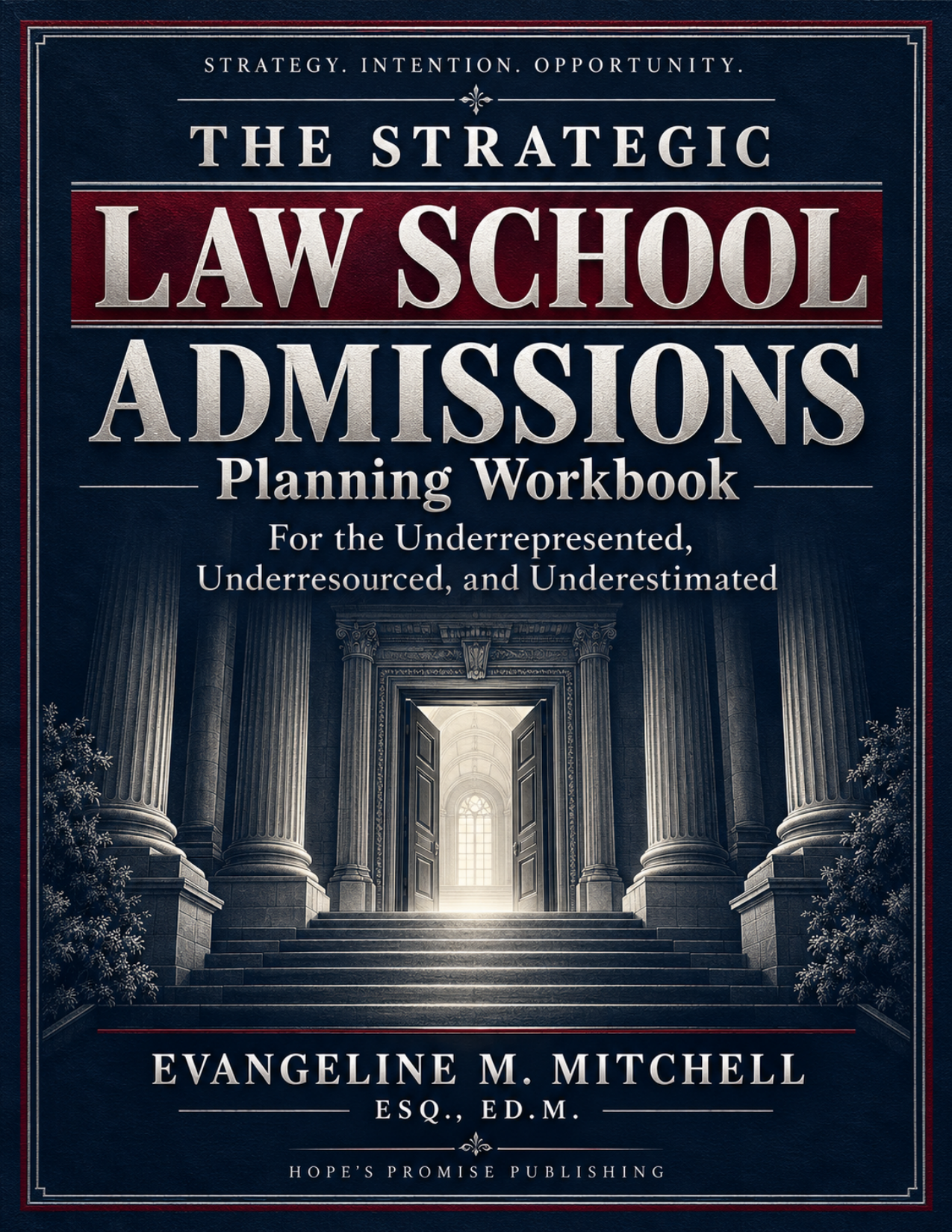
The Strategic Law School Admissions Planning Workbook
For the Underrepresented, Underresourced, and Underestimated
Strategy. Intention. Opportunity. A working planner — not a passive read — that walks you through the law school admissions process step by step, so you can build a plan that fits your real life.
Fillable PDF — type in it on your computer or print it and write by hand.
“To aspiring lawyers and future leaders — to those who were told to wait their turn, who had to figure it out on their own, and who are doing it anyway.”
From the dedication
Why This Workbook Exists
Planning cannot promise an admission. It can put the next decision in your hands.
Getting into law school is competitive. Like many first-generation college students, Evangeline Mitchell thought she was doing all the “right” things — good grades, involvement, hard work. Then a friend shared resumes and personal statements from students at an Ivy League law school, and she was stunned. She had no idea what competitive really looked like.
She had not been intentional. She had not been strategic. She had not been planning toward a specific outcome. That moment changed her approach to everything that followed — and shaped the philosophy behind this workbook.
This is not a passive read. It is a working planner. You will write in it, cross things out, update it, revisit it, and adjust your plans as you grow. A workbook only works if you actually work it.
What's Inside
Inside This Workbook, You Will Find
Every page is built to be used — filled in, marked up, and revisited as your plan evolves.
- A one-page application dashboard to anchor your entire plan
- Your First 30 Minutes — a guided session that ends with one real next step
- Honest self-assessment and 'Why Law?' foundational reflection
- Your 'Wow' or 'X' Factor — identifying what makes you unforgettable
- SMART goals, yearly priorities, and a master strategic plan
- LSAT vs. GRE decision tools plus a practice log
- LSAC fee waiver awareness and pipeline programs worth knowing
- Application-to-enrollment calendar and school research matrix
- Personal statement, diversity, and 'Why This School' drafting trackers
- Recommendation letter tracker and the Recommender Brief template
- Funding plan, affordability worksheet, and scholarship negotiation
- Final 30 days before submission checklist and readiness review
The Four Parts
A complete system, from first reflection to final submission
Understanding the Law School Admissions Process
- What admissions committees actually consider
- Understanding holistic admissions
- The splitter reality (high GPA / low LSAT, or vice versa)
- The hidden curriculum and common mistakes to avoid
Self-Assessment, Reflection, and Vision
- Why Law? — the foundational reflection
- Turn life experience into specific evidence
- Your vision statement and daily success principles
- A 90-day plan from where you actually are
Building Your Strategic Plan
- Yearly priorities and a master strategic plan
- SMART goals and specific action steps
- LSAT or GRE preparation and practice logs
- Fee waivers and pipeline programs
Professional Development and Application Mechanics
- Informational interviews and your elevator speech
- Application-to-enrollment calendar and research matrix
- Essay, statement, and recommendation trackers
- Funding plans, affordability, and the final 30 days
Start Here
Tools that meet you where you are
You do not need to finish this workbook today. Begin with the first half hour and leave with one realistic next step.
Your First 30 Minutes
A timed, six-step opening session that leaves you with an honest starting point and one scheduled next action.
My Application Dashboard
One page that captures your stage, hours, budget, priorities, and next actions — revisit it whenever the plan changes.
Worksheet Guides
Two guides — reflection and planning, applications and decisions — that turn your answers into actions.
Worked Plans
Filled-in example plans for a college student and a working adult, so you can see what the process looks like.
Monthly Review
Record progress, name unanswered questions, choose the next action, and adjust your timeline.
A Few Terms to Know
Plain-language definitions of the admissions vocabulary you will meet along the way.
Your Route
Choose the route that fits your stage
Build foundations: explore admissions, reflect early, set realistic yearly priorities.
Focus on reflection, school research, test preparation, and potential recommenders.
Run the application calendar: essays, recommendations, school selection, and funding.
Plan by stage instead of college year — start where you are, and strengthen the evidence.
Revisit monthly: record progress, identify unanswered questions, choose the next action, and adjust your timeline. Your route can be different and still be intentional.
Who This Is For
Written especially for the underrepresented, underresourced, and underestimated
Access to information, financial cushion, family networks, and experienced guidance is uneven. That is not your fault — and you do not have to navigate it alone. You belong in this profession, and the legal profession needs your perspective, your voice, and your lived experience.
- First-generation college students
- Students from communities of color
- Low-income and underresourced students
- Rural and returning adult learners
- Neurodivergent and disabled students
- Immigrant and undocumented students
- LGBTQ+ applicants
- The formerly incarcerated
- Applicants without pre-law mentorship
- Pre-law advisors and pipeline programs
Strategy. Intention. Opportunity.
Use it. Mark it up. Make it yours.
Enter your full name and email and we'll send you a link to read it online or download the free reader-testing edition. Open it alongside your calendar, and leave your first 30 minutes with one realistic next step.
This is a reader-testing edition. The workbook is still being refined and improved ahead of its wider release, so your copy may get even better. No spam. Just your download link.
FAQ
Frequently Asked Questions
Is the workbook really free?+
Yes. This reader-testing edition is a free download. You can read it, print it, and start using it right away.
Can I fill it in on my computer, or do I have to print it?+
Both. The PDF includes response fields you can type into with a PDF reader that supports forms — or you can print it and write by hand. Save a personal copy as you go.
Do I have to complete every page in order?+
No. Start with the dashboard, choose the route that fits your stage, and revisit the monthly review. You do not need to finish every page.
Does it help me decide between the LSAT and the GRE?+
Yes. Part Three includes LSAT vs. GRE decision support, a preparation section, and a practice log.
I'm a returning adult learner. Is this for me?+
Absolutely. A dedicated non-traditional section helps you work with your established record, your responsibilities, and a plan by application stage rather than college year.
What is a reader-testing edition?+
It's a working edition shared so readers can use the workbook and tell us what to improve. The book includes a Reader Feedback section — your input helps shape the final edition.